When people think about the economic costs of climate change, they often picture flooded homes, damaged infrastructure or disaster recovery. Yet some of the most significant costs may arise through a less visible pathway: human health.
Climate-related hazards, including extreme heat, flooding and storms, can affect physical and mental health. So much so that the UK Health Security Agency identifies climate change as a growing public health risk in the UK.
To help policymakers understand and incorporate these risks into decision-making, GAD has recently supported a range of climate and health-related projects. These aim to improve understanding of how climate-related changes in population health may affect:
- public services
- public finances
- wider economic outcomes
This includes systems mapping and quantitative modelling to help policymakers explore long-term risks and potential policy responses.
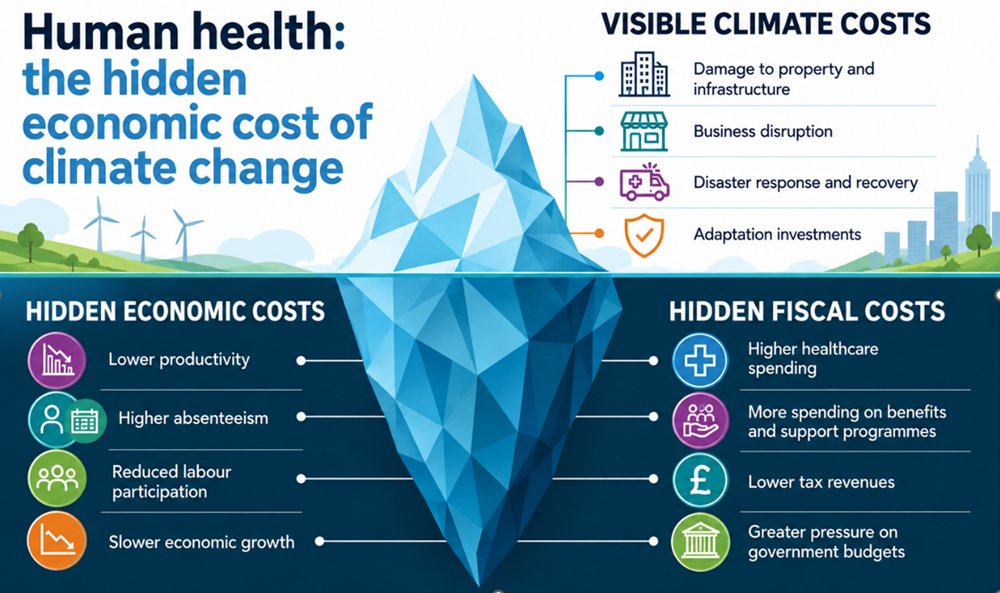
Climate driven health impacts have implications for workforce participation, productivity, healthcare demand and public finances. Unlike damage to buildings or infrastructure, however, many of these effects are not immediately visible and can be difficult to quantify. One way to think about the economic consequences of climate-related hazards is as an iceberg. While damage to infrastructure and property is often visible, many wider costs emerge indirectly, including through impacts on population health.
Figure 1 provides a simplified illustration of how some climate-related economic impacts may be more visible than others.
Health and economic performance
Population health is an important determinant of economic performance. It affects people’s ability to work, their productivity and their use of public services. Even before considering climate change, ill health creates significant economic and fiscal pressures. For example:
- The Office for National Statistics (ONS) reported that UK healthcare expenditure (incorporating both public and private spend) was around £345 billion in 2025, equivalent to more than 10% of UK GDP.
- The Department for Work and Pensions (DWP) estimated that health-related barriers to employment cost the UK economy £240-330 billion in 2022.
- DWP also estimates that annual spending on health-related benefits, including incapacity and disability benefits, will exceed £70 billion by the expected end of the current parliament in 2029.
These figures illustrate the scale of existing health-related challenges.
Allowing for the effects of climate change may impact these costs substantially. Analysis by the Grantham Research Institute at the London School of Economics estimates that climate-related mortality could reduce UK gross domestic product (GDP) by around 0.4% on average over the end-of-century period (2081-2100). This estimate is based on a current policies scenario, which assumes existing global climate commitments are implemented but no additional mitigation action is taken.
However, mortality represents only one aspect of climate-related health impacts, and the estimate does not capture wider effects such as ill health, pressures on healthcare services or productivity losses.
Climate change and population health
Climate change may affect not only mortality, but also the number of years people spend in good health. Measures such as healthy life expectancy can help us understand these wider impacts and their implications for individuals, public services and the economy. This is discussed further in GAD's blog, Not all years lived are equal: understanding measures of health.
Over time, some risks associated with extreme cold may decline, and climate mitigation and adaptation can generate important additional health benefits.
Actions to mitigate climate change can also generate health benefits, for example through improvements in air quality that may reduce some respiratory illnesses. However, risks associated with extreme heat and other climate-related hazards are expected to increase. The scale, timing and overall consequences of future impacts remain uncertain and will depend on factors such as:
- location
- population vulnerability
- the extent of future climate change
- the effectiveness of adaptation measures
If climate change adversely affects population health, it could compound existing challenges such as population ageing and stalling healthy life expectancy. These impacts are unlikely to be distributed evenly, with some groups potentially facing greater health risks and having fewer opportunities to adapt, contributing to wider social inequalities. This would further increase pressures on labour markets, welfare spending and public services.
The health-related economic burden
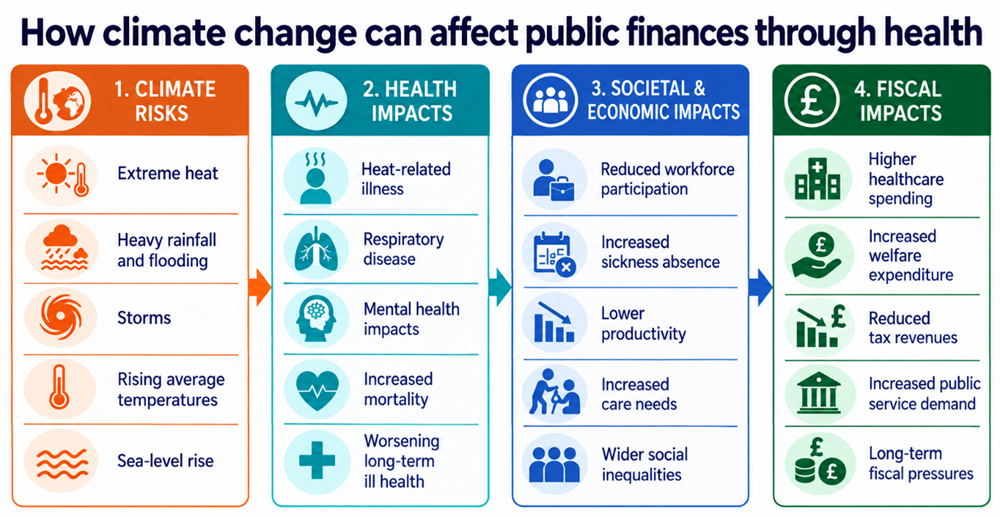
Climate-related health impacts do not affect the economy through a single route. They can influence labour markets, public services and public finances through multiple interconnected pathways. These effects may reinforce one another through feedback loops, making the overall impact difficult to assess in isolation. While simplified, the graphic below illustrates some of these potential pathways.
Case study: Heat-related productivity losses
Heat-related productivity losses provide a tangible example of how climate-related health impacts can affect economic performance, even before considering healthcare costs and other wider economic effects.
The effects can extend beyond occupations involving direct outdoor or physical exposure. Hot conditions can also affect indoor workplaces, potentially reducing productivity across a much wider range of occupations.
Experimental analysis from the ONS estimated that hot weather may have reduced productivity in Great Britain by an average of £1.2 billion per year between 1998 and 2021. Modelled losses reached £5.3 billion during the exceptionally hot conditions of 2020.
As hot days become more frequent or intense, heat-related productivity losses could increase. Future impacts will depend on many factors, including the effectiveness of adaptation measures such as cooling, heat-health alerts and changes to working practices.
Connecting climate, health and economic policy
Although some climate-related health effects may be reflected in GDP, the measure alone does not capture their full impact on wellbeing or public finances. For example, higher healthcare spending may increase measured economic activity while also reflecting worsening health outcomes and greater demands on public resources.
Existing tools such as the Office for Budget Responsibility’s Fiscal Risks and Sustainability reports and HM Treasury's Green Book already support long-term risk assessment and policy appraisal. As evidence develops, climate-related health impacts could be considered more explicitly, helping provide a fuller picture of long-term risks.
Making the hidden costs more visible
GAD has recently explored these issues through a range of climate and health-related projects, including:
- Climate-health systems mapping, improving understanding of the pathways through which climate-related risks may affect health outcomes, public services and wider societal resilience. Insights from this work will be published in a future blog.
- Quantitative analysis exploring how changes in population health associated with long-term increases in temperature may affect demand for welfare benefits. This work has helped policymakers assess the potential implications for long-term public finances and explore potential policy responses.
These projects illustrate how GAD’s support is helping policymakers understand and respond to the wider economic consequences of climate-related health impacts.
Looking ahead
As climate risks intensify, understanding their implications for population health may become increasingly important. These impacts are relevant not only to public health policy, but also to decisions affecting labour markets, welfare systems and the long-term sustainability of government finances.
GAD operates at the intersection of government policy, long-term financial sustainability, uncertainty and analytical assurance. We combine actuarial analysis with expertise in climate science and work closely with specialists in areas such as public health and economics. By bringing these perspectives together, we can help make the hidden health-related costs of climate change more visible, supporting better-informed government decisions.
Disclaimer
The views expressed are the author’s own and the opinions in this blog post are not intended to provide specific advice. For our full disclaimer, please see the About this blog page.
Recent Comments