Climate change, energy security, artificial intelligence, demographic change and public service reform are among the defining policy challenges of our time.
Addressing them requires more than incremental improvements. It requires transformational change - action that reshapes the systems, behaviours and incentives that determine long-term outcomes.
Whether decarbonising the economy, adapting public services to demographic change or harnessing artificial intelligence, the effects of these interventions can unfold over decades.
Yet policymakers must make decisions today based on assumptions about how the future will develop. Doing so is particularly challenging for transformational projects, which, by definition, are designed to reshape the systems, behaviours and incentives that drive future outcomes. Because they seek to change the very conditions on which forecasts are based, their long-term impacts and value are inherently uncertain.
Responding to the challenge
Across government, there is growing recognition that appraisal and decision-making approaches must evolve to meet this challenge.
At the centre of this effort is HM Treasury's Green Book, which provides guidance on how departments assess the costs, benefits, risks and wider impacts of policies, programmes and projects.
Recent developments, including the 2025 Green Book Review, place greater emphasis on risk, non-monetisable impacts and strategic objectives. They recognise transformational decisions cannot always be captured through simple benefit-cost ratios alone, particuarly when outcomes are uncertain and unfold over long periods.
This reflects a broader shift in how policymakers think about decision-making under uncertainty. Transformational decisions are often characterised by deep uncertainty, where future conditions cannot be predicted with confidence. For issues such as climate change, artificial intelligence and demographic change, the challenge is not to forecast a single future, but to consider how different futures might emerge.
As a result, public sector appraisal is being asked to place greater emphasis on longer-term public value, resilience and adaptability alongside traditional measures of value for money, supporting decisions that remain robust as circumstances evolve.
Appraising transformational change
Additional challenges in appraising transformational policies arise from their potential to create system-wide impacts and wider societal effects. These effects may extend across interconnected sectors and stakeholders and can be difficult to identify, quantify and compare consistently within appraisal frameworks.
These implications may include benefits such as resilience, wellbeing, environmental improvements and long-term economic adaptability. Such benefits can be central to a policy's overall value but may be more difficult to assess consistently within conventional appraisal approaches.
Decarbonisation provides a useful illustration. Future benefits depend not only on future climate policy and technological progress, but also on how households, businesses and markets respond to policy interventions. As behaviour and incentives change, the assumptions underpinning initial forecasts may themselves evolve, creating a wider range of possible future outcomes.
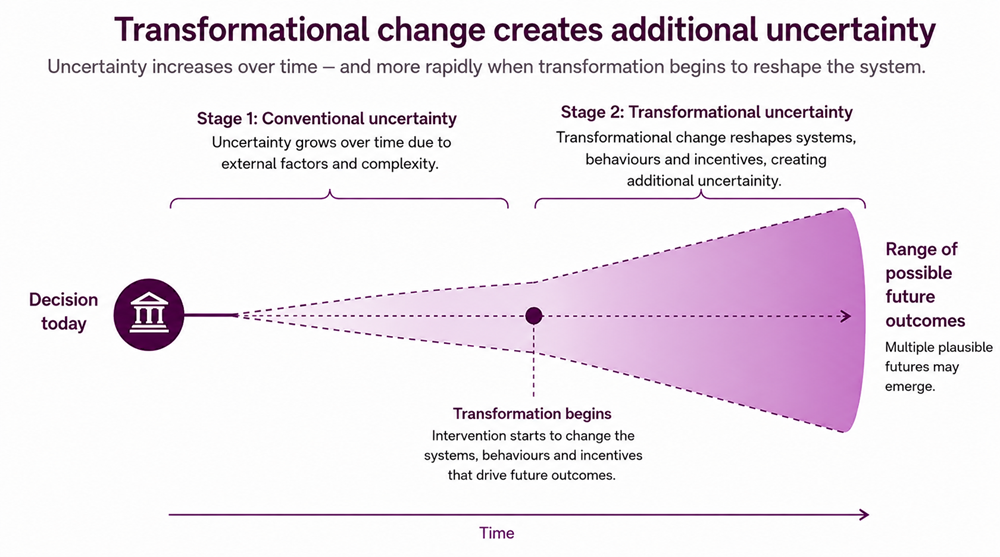
These characteristics of transformational investments - involving system-wide impacts, long time horizons and deep uncertainty – therefore require a broader approach to appraisal.
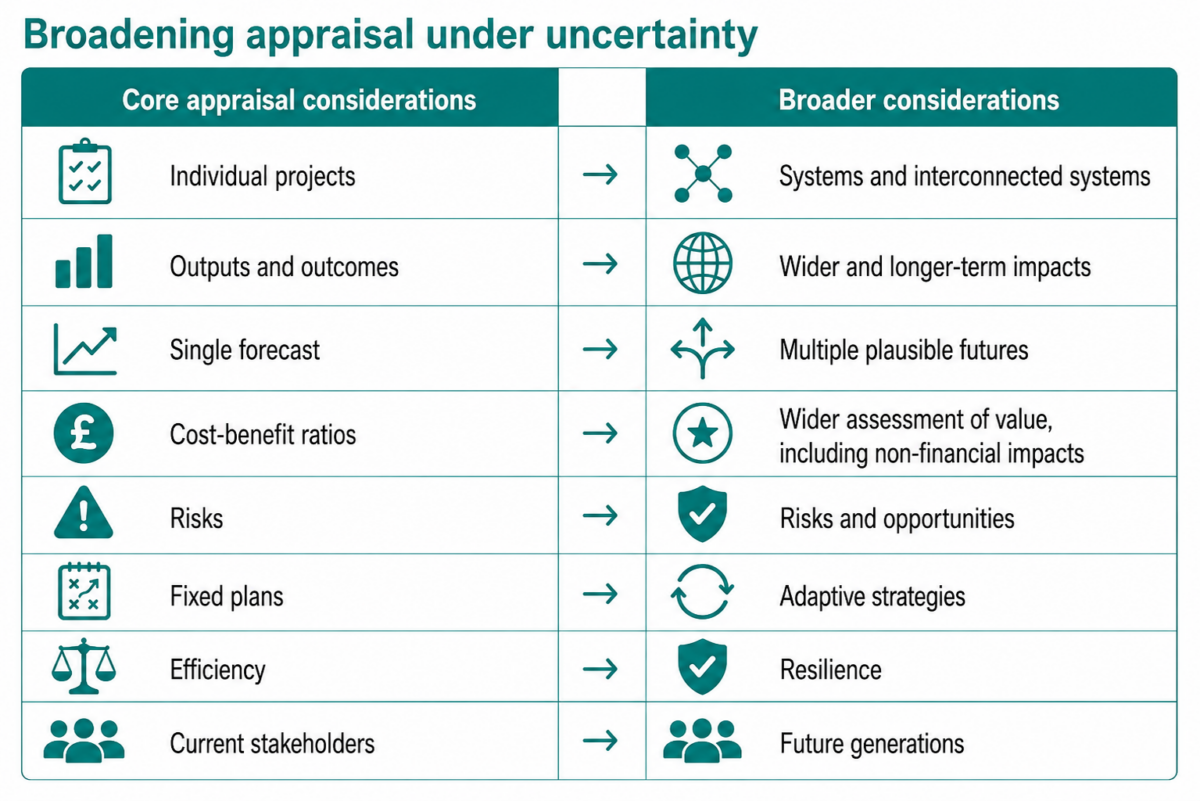
Approaches such as scenario analysis, stress testing and adaptive planning can help decision-makers understand how policies may perform under different future conditions. Rather than seeking a single "best estimate" of the future, these methods help evaluate the robustness of decisions across a range of plausible outcomes.
The actuarial contribution
Many of these approaches draw on capabilities that are familiar to actuaries.
Actuaries routinely work with uncertainty, long time horizons and complex systems. Whether assessing pension liabilities, insurance risks, climate-related exposures or the implications of demographic change, actuarial work often involves evaluating how different future scenarios could affect outcomes. Actuaries are also practiced in effectively communicating how decisions impact across a range of possible futures.
Tools such as scenario analysis, stress testing and long-term modelling are already widely used within the profession. These techniques can provide valuable insights for policymakers seeking to understand the implications of uncertainty and the trade-offs associated with different strategic choices.
As governments confront increasingly complex and long-term challenges, these skills become increasingly relevant. By bringing a structured approach to uncertainty, risk and resilience, actuarial thinking can help support more informed and adaptable decision-making.
Looking ahead
The Green Book Review marks a new approach to appraisal in the public sector. Public-sector appraisal must be able to capture transformational change, wider societal impacts and long-term value alongside traditional measures of value for money.
Important challenges remain, however. While there is growing recognition of the need to consider uncertainty, resilience and broader public value, incorporating these factors consistently into decision-making remains difficult. Further work will be needed to develop frameworks that are robust enough to reflect these considerations while remaining proportionate and practical for routine use across government.
The debate is no longer whether uncertainty matters, rather it is a question of how best to account for it. In this context, the government continues to develop its approach to transformational policymaking. Green Book reforms and emerging professional thinking provide a stronger foundation for making decisions with long-lasting consequences. Getting these decisions right matters because they will affect citizens, public services and the wider economy for generations.
Ultimately, the goal is not to predict the future perfectly, but to make decisions that remain credible, resilient and adaptable as circumstances evolve. By being robust across a range of possible futures, well-designed policies today can help shape a better future tomorrow.
Disclaimer
The views expressed are the author’s own and the opinions in this blog post are not intended to provide specific advice. For our full disclaimer, please see the About this blog page.
Recent Comments