Public sector bodies need to understand how climate change could affect their services, operations and finances. Departments are expected to assess and manage climate-related risks through requirements including:
- Task Force on Climate-Related Financial Disclosures (TCFD)-aligned reporting
- the Greening Government Commitments (GGCs)
- policy appraisal under the Green Book
Climate scenario analysis supports robust decision-making by helping us understand current climate-related risks and how they could change in future, enabling us to identify practical mitigation and adaptation actions.
However, a common sticking point is: “We want to understand the operational and financial impacts of future climate change, but we don’t have the data.”
In the public sector, this is compounded by the fact that the underlying value of services is not always straightforward to quantify in financial terms, and the consequences of disruption can be far-reaching.

Qualitative approaches
This is where qualitative approaches can help. Done well, they are not a second-best substitute for numbers. They are a practical, decision-focused way to start climate scenario analysis when quantification is constrained. They can also add additional insight even when quantitative analysis is available.
At GAD, we support departments and public sector organisations to undertake climate scenario analysis using a mixture of quantitative and qualitative approaches. Where it is proportionate and feasible, we quantify potential financial impacts of climate change. But we also see many situations where a qualitative approach is the right starting point, and sometimes the right end point, depending on the decisions being made.
This blog highlights how qualitative approaches strengthens climate scenario analysis when data is limited, helping public sector organisations generate decision-useful insights and identify practical resilience actions.
What climate scenario analysis is (and why you are being asked to do it)
Climate scenario analysis is a decision-useful tool that enables organisations to explore and assess the potential impacts of a range of plausible climate futures in a structured way.
It is not about predicting a single outcome but about exploring how your organisation might perform under different future conditions so you can look to adapt to future change and build resilience.
TCFD places scenario analysis at the centre of understanding climate-related risks and pushes organisations towards demonstrating how robust their strategy is under different climate futures.
Importantly, TCFD recognises that organisations may start with qualitative approaches and iterate towards more quantitative approaches as data and capability improve.
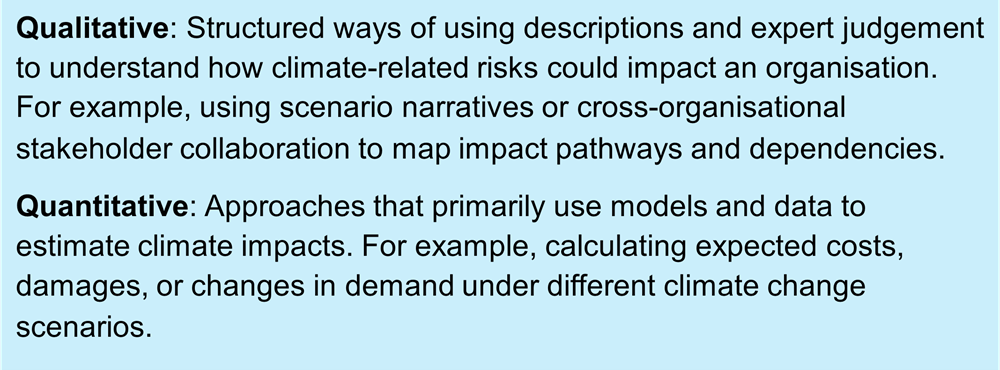
Approaches to climate scenario analysis
Why quantitative analysis may not always be possible
There are often good reasons why teams get stuck trying to quantify future climate impacts.
- The hazard is uncertain - the climate hazard (such as extreme rainfall) can be difficult to quantify at the level of detail needed to inform decisions. Hazards are often highly location-specific. Data may lack the granularity needed for decisions or fail to capture compound and cascading risks that drive operational or financial impacts (for example, intense rainfall following a wet period, or multiple hazards in quick succession).
- Lack of vulnerability or exposure data - even if you could describe the hazard perfectly, you may not be able to quantify how your organisation is affected because the vulnerability and cost evidence is scarce. Common issues can include:
- incomplete or inconsistent asset information
- limited understanding of failure thresholds (for example, what level of flood depth disrupts a site).
- weak data on operational disruption (for example, what happens in practice when a site is partially unavailable)
- limited understanding of cost of disruption
- hidden dependencies (for example, power, key suppliers, access routes)
This is not a sign of poor practice. It is typical in complex organisations, and it is exactly why alternative methods to full quantitative analysis are useful.
Imperfect data should not mean inaction
If you wait until you can quantify everything, you may never start. Meanwhile decisions continue:
- capital spending plans are set
- maintenance is prioritised
- service changes are implemented
These can lock in vulnerability or, conversely, create resilience.
Qualitative methods can be a way to make progress on understanding climate-related risks and their impacts now even if data for financial quantification of the risk is limited. The same approaches may also help teams assess nature-related risks, where data is also often limited and metrics are still emerging.
Why qualitative methods add value (even when you have the numbers)
Qualitative methods are often presented as “what you do until you can quantify”. That undersells their value. In practice, these approaches can improve decision-making in ways that a solely quantified output often cannot.
They can help you understand how climate-related risks turn into disruption and financial cost and identify where resilience measures will make a difference. When it comes to climate scenario analysis, qualitative approaches can have the following benefits:
- They make climate-related risks real for decision-makers and drive engagement
Senior leaders need to understand what a risk means for delivery: what fails, what choices exist, and what trade-offs are implied. Using well-crafted qualitative scenarios allow decision-makers to picture different futures and interrogate resilience in a practical way.
A well-designed qualitative exercise brings the right people together: finance, estates, operations, procurement, digital, risk and policy. That process can be as valuable as the output. It builds a shared understanding of what matters, where uncertainty sits, and who owns which actions across the organisation. - They make pathways visible, not just outcomes
Qualitative approaches encourage you to map the chain from hazard to consequence in a way that people across the organisation can understand, helping teams see what a changing climate could mean for their own area of work and avoiding jumping straight to a number without understanding what assumptions sit underneath it. - They can capture system-wide and compounding impacts
Public sector services are delivered through systems: estates, people, suppliers, digital infrastructure, partners and communities. Qualitative methods are often well suited to exploring how climate hazards can cascade across those systems or compound. Examples could include a heatwave that coincides with high service demand and staff shortages or repeated surface water flooding that creates cumulative asset degradation and repeated closure. These systems and dynamics are often complex and difficult to model. Qualitative methods can help you map connections and identify where vulnerabilities and resilience sit across your organisation. - It produces practical output
A common misconception is that qualitative analysis produces ‘nice narratives’ but little else. In fact, it can generate highly practical outputs such as sets of priority risks and vulnerabilities or practical adaptation or risk mitigation actions. You can also use your findings to create a targeted data collection plan that can support future quantitative analysis.
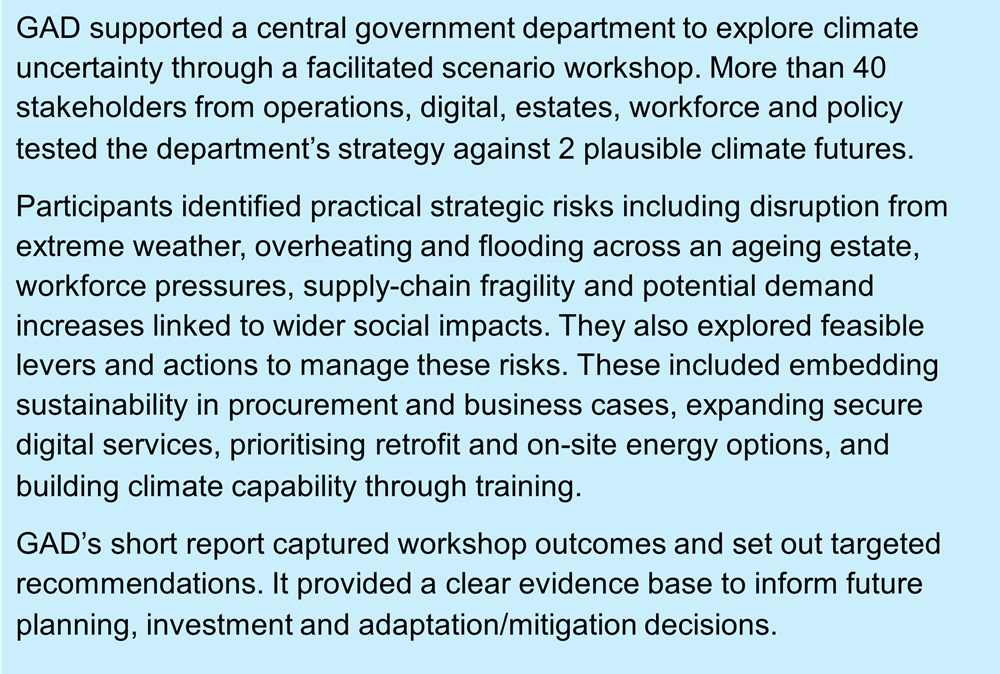
From climate uncertainty to targeted recommendations: a qualitative climate scenario workshop
So, if you do not have perfect data, qualitative approaches to climate scenario analysis are a credible and TCFD-aligned starting point. GAD can support public sector organisations to get started with climate scenario analysis and help you build capability over time, using a proportionate mix of qualitative and quantitative approaches.
For practical guidance, see GAD’s “Getting started with scenario analysis”, and the Government Office for Science’s Futures Toolkit, which provides tools and templates for exploring uncertainty and testing decisions against different futures.
Disclaimer
The views expressed are the author’s own and the opinions in this blog post are not intended to provide specific advice. For our full disclaimer, please see the About this blog page.
Recent Comments